
Table of Contents
How to Create a TikTok and Instagram Content Funnel to Drive Traffic into a New Online Community
If you’re a creator, blogger, or community builder looking to grow your audience, then leveraging the combined power of TikTok and Instagram with a structured funnel might be your game-changer. This article will walk you through how to create a TikTok and Instagram content funnel that attracts attention, engages your audience, and ultimately converts them into members of your online community.
What is a Content Funnel (and why use TikTok + Instagram)?
A content funnel is a strategic process that guides people from being unaware of you, to engaging with your content, to eventually taking a meaningful action — in your case, joining an online community. Social media platforms like TikTok and Instagram aren’t just random posting grounds — when used together, they can create a smooth journey from discovery to conversion.
- TikTok provides quick, high-reach, discovery-driven content (great for awareness).
2. Instagram offers a variety of formats — Reels, Stories, carousels, Lives — ideal for deeper engagement and community nurturing.
3. By aligning TikTok + Instagram, you tap into both spontaneous discovery (TikTok) and relationship building (Instagram) which together make for a powerful funnel.
Research shows that social media marketing funnels work best when each stage uses content tailored to where your audience is in their journey.
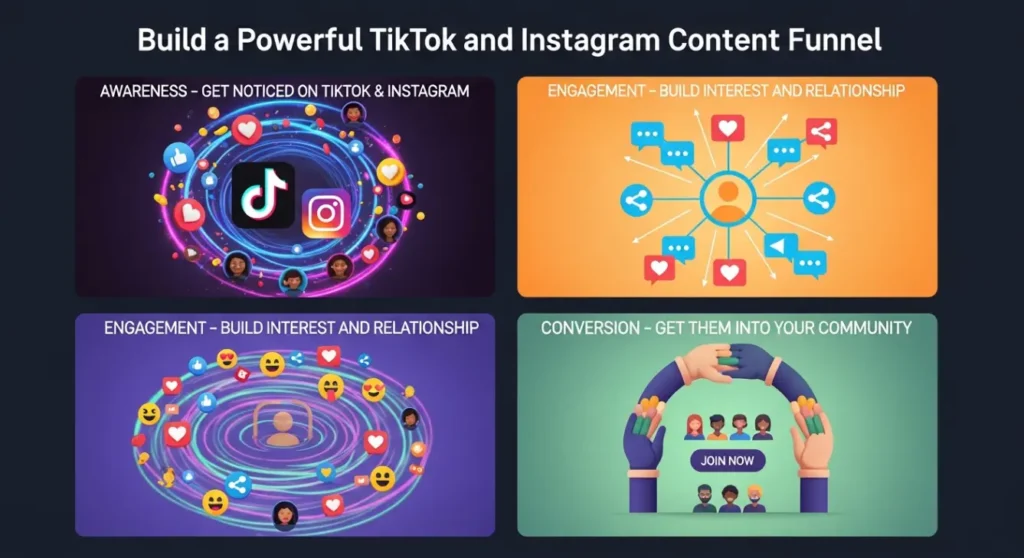
Stage 1: Awareness – Get Noticed on TikTok & Instagram
Goal: Reach new eyeballs, build curiosity
This is the top of funnel. You want broad exposure, grabbing the attention of people who might be interested in your community but don’t yet know you exist.
Content examples:
TikTok: Short, punchy videos (15-30 s) showing a “hook” — a quick insight, a surprising fact, or something entertaining related to your niche.
Instagram Reels & Explore: Similar short-form video tailored for Instagram (use the same or adapted version from TikTok).
Instagram Feed Post or Carousel: A bold statement or stat, something attention-grabbing that causes someone to stop scrolling.
Instagram Stories with Polls/Questions: Use Story tiles to tease your upcoming community or ask a question to seed interest.
Conversion tip:
Include a call-to-action (CTA) like: “Want the full community vibe? Link in bio” or “Join me for deeper conversation—swipe up/visit link.” This directs people to your Instagram profile or to a landing page where they can learn more or sign up.
Practical Tip:
Use trending sounds on TikTok to maximize reach, but tie them directly to your niche so the viewers are relevant.
On Instagram, make your bio clear with a link to your new community (landing page, group, etc.).
Use UTM parameters or trackable links to monitor how many people came from each platform.
Stage 2: Engagement – Build Interest and Relationship
Goal: Engage and nurture curiosity so your audience sees value in joining your community.
Now that you’ve captured attention, shift to content that creates trust, interest and keeps your audience wanting to know more.
Content examples:
TikTok: “Behind-the-scenes” videos, short how-tos, story-based content (“Here’s how I started our community…”), or micro-educational pieces.
Instagram Stories & Story Highlights: Q&A sessions, polls, “Ask me anything” stickers, little glimpses into your community or what members get.
Instagram Carousel Posts or Reels: Break down a mini-lesson related to your community topic (“5 steps to…”, “Top tools for…”, etc.).
Instagram Lives or TikTok Lives: Host a live session about the community topic, invite early joiners or guests to talk about what it’s like.
Conversion tip:
At this stage, the CTA evolves: “Want deeper access? Reserve your seat in the community.” Or “DM me ‘JOIN’ to get your invite link.” The goal is to shift from general interest to a smaller subset who are ready to take action.
Practical Tip:
Maintain consistency: If you’re posting one TikTok per day for awareness, aim to post 2-3 Instagram Stories and one carousel or Reel per week for engagement.
Use analytics: Check which TikToks generate profile visits or link clicks; on Instagram check Story forwards/backwards, engagement rate on carousels. According to SocialInsider, mapping each stage to specific metrics is key.
Social insider:
Make your content platform-appropriate: For TikTok use vertical immersive format, for Instagram Stories use stickers, for Reels ensure the hook appears within the first 2-3 seconds.
Stage 3: Conversion – Get Them into Your Community
Goal: Convert engaged followers into actual members of your online community.
This is the bottom of funnel. The audience now knows who you are and what you offer — time to make it easy for them to take that next step.
Content examples:
Instagram Lives (with link in comments/description): A talk about why the community exists, what members get, and a live Q&A to handle objections.
TikTok with Link in Bio / Comments: A video inviting people to join, featuring highlights from your community, testimonials, or success stories.
Instagram Carousel Post: “Here’s what you get when you join…”, followed by a CTA swipe to “Join the link in bio”.
Instagram Story with Countdown Sticker: Launch of the community, limited spots, or early bird discount, with swipe-up link or link sticker.
Conversion strategy:
Landing page or signup form: A simple one-page that explains benefits, social proof, and a strong CTA.
Incentive: Offer an early bird bonus, a free workshop, an exclusive zoom call, or gated content for joining.
Follow-up: For those who clicked but didn’t join — send a DM or Story follow-up (on Instagram) to nudge them: “Still thinking? Here’s what you’d miss.”
Practical Tip:
Make the joining process friction-free: the fewer steps, the better.
Use tracking links from your TikTok and Instagram to see exactly which channel drove the most conversions.
Retarget: Use Instagram & TikTok retargeting tools (or paid ads if you have budget) to reach those who visited the page but didn’t join yet.
Putting the Funnel Together: Cross-Platform Flow
Here’s a simple flow you can implement:
- TikTok video → Hook & tease (Awareness) → ends with “Check link in my Instagram bio”
2. Instagram bio → Link to landing page or “Join my new community” page
3. Instagram Story → Highlight benefits, show members, include CTA “Join now” (Engagement → Conversion)
4. Instagram Live → Discuss community, bring questions, invite sign-up on the spot
5. Community welcome sequence → Welcome email, first post in community, ask new members to introduce themselves (post-conversion nurturing)
By weaving TikTok and Instagram together, you create a unified funnel rather than treating each platform in isolation. One platform drives the initial traffic; the other builds deeper connection and community conversion.
Practical Tips for Consistency, Analytics & Optimization
Consistency
Create a content calendar for both platforms. For example:
>Mondays: TikTok awareness video
>Wednesdays: Instagram Reel or carousel
>Fridays: Instagram Story Q&A or TikTok behind-the-scenes
>Monthly: Instagram Live or TikTok Live with community invite
Repurpose content smartly: Use the same core idea but tailor execution platform-wise (format, length, CTA wording).
Analytics
Set clear KPIs for each funnel stage:
>Awareness: impressions, reach, new followers
>Engagement: saves, shares, Story replies, link clicks
>Conversion: landing page traffic, join rate, cost per join (if paid)
As noted in social-funnel guides, each stage uses different metrics.
Use tracking links, UTM parameters, and platform analytics (TikTok Pro account, Instagram Insights) to identify which video/content pieces are performing best.
>Use A/B testing: test different hooks, formats, CTAs, posting times. For example, Instagram ad research stresses using the right creative for the right funnel stage.
Bestever
Optimization
If a TikTok video drives lots of profile visits but low clicks to your landing page, adjust your CTA or landing page.
If your Instagram Stories have high view rate but low swipe-ups, maybe your offer isn’t compelling — test a new incentive.
Keep iterating: Content formats change, platform algorithms shift. What worked last month may need refreshing this month.
Common Mistakes to Avoid
->Posting without purpose: Random content without funnel thinking means you may get followers but no movement into the community.
->Using same content for every stage: Awareness content will not perform like conversion content — your CTAs and formats must change.
->Neglecting one platform: If you focus only on TikTok or only on Instagram, you lose the advantage of a cross-platform funnel.
->Ignoring analytics: Data tells you where users drop off; without it you’re flying blind.
->Over-selling too early: If you push the conversion invite immediately in the first post, you may scare away people who are not yet ready. Build trust first.
Conclusion
Creating a strong TikTok and Instagram content funnel to drive traffic into a new online community is entirely achievable — when you structure it correctly and align your content to the funnel stages: Awareness → Engagement → Conversion. Use TikTok to cast your net wide and Instagram to deepen connection and guide followers into community membership. With consistent content, strong calls-to-action, proper tracking and iterative optimization, you’ll be well on your way to building a thriving, engaged online community.
Action Plan / Key Takeaways
Set up your funnel map: awareness (TikTok/Reels) → engagement (Stories, carousels) → conversion (Lives, landing page)
Create a content calendar for both platforms with defined formats and CTAs.
Craft platform-appropriate content: TikTok = reach; Instagram = nurture.
Add clear CTAs at every stage: “Link in bio”, “Swipe up”, “Join now”.
Use analytics and tracking links to measure each stage’s performance.
Test and optimize formats, hooks, CTAs regularly.
Avoid pushing for conversion too early; build relationship first.
Keep the community experience strong — once they join, nurture them.