
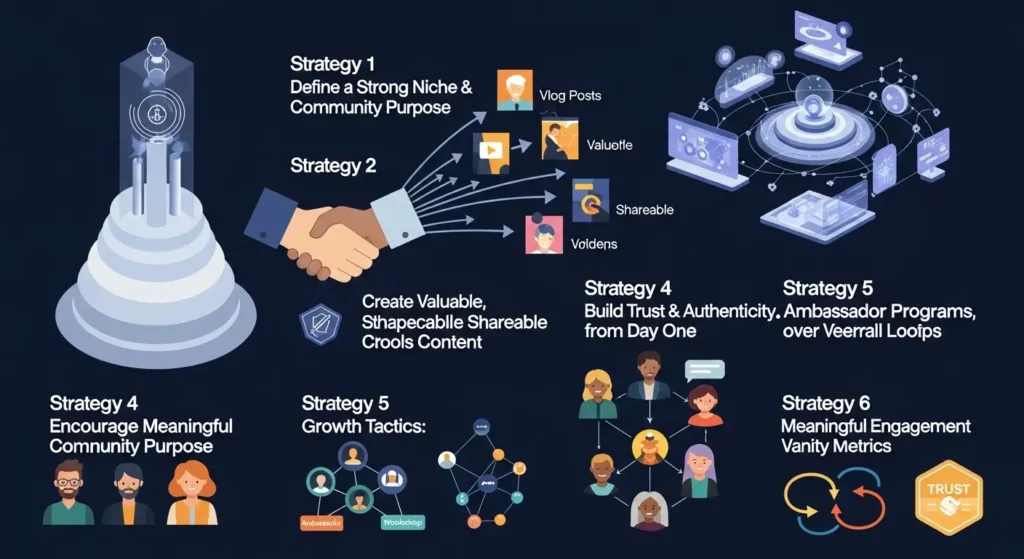
Most effective community-building strategies in 2025
Introduction
Starting an online community is exciting—but reaching that first 1,000 members who are active, engaged, and committed is what separates a hobby from something that thrives. In 2025, with evolving platforms, increased noise, AI tools, and higher expectation for authenticity, the strategies that worked a few years ago may not be enough.
In this article, I’ll share 7 proven strategies to attract your first 1,000 highly engaged members. These aren’t vague ideas; they include real examples, tools, and things you can start doing today. I’ll also flag common pitfalls so you can avoid early missteps. Let’s dive in.
Strategy 1: Define a Strong Niche & Community Purpose
What that means
A niche is a specific, focused segment of people with shared interests, identities, or problems. Community purpose is the “why” — the shared mission or value that brings people together. When both are crystal clear, you attract members who deeply care—and are likelier to engage and stay.
Example:
- A learning community for urban sketchers (artists who sketch cityscapes outdoors) chooses purpose: “help members grow their urban sketching skills, share tools & techniques, and organize weekly sketch walks.”
- Another example: a professional community for sustainable packaging innovators, with mission to reduce waste. Niche = packaging professionals + sustainability, not simply “designers.”
What you should do:
- Write out your community’s mission in 1-2 sentences.
- Describe your ideal member: their background, desires, pain-points.
- Identify what exactly makes you different from generic communities.
- Use that niche & purpose as filter for decisions: content topics, platform, partnerships.
Pitfalls to avoid:
- Being too broad: “creatives,” “artists,” “writers” are big. Without sub niches (e.g. fantasy writers, watercolor artists), you’ll struggle to stand out.
- Changing mission too often: members get confused or feel betrayed.
- Purpose that is vague or generic: “we help people grow online” is weak without specifics.
Strategy 2: Leverage Emerging Platforms & Tools of 2025
What to pay attention to:
Platforms and tools continue to evolve. Choosing the right platform early helps you both reach people where they are and provide features that support good engagement.
Some 2025 trends:
- AI-powered personalization & moderation — tools that surface posts matching member interests, flag inappropriate content, or offer suggestions.
- Niche community platforms (Circle, Mighty Networks, Hivebrite, Bettermode etc.) that combine content, events, private groups, and membership tools.
- Community-management tools & automation (moderation workflows, onboarding sequences, scheduled posts) to reduce manual load and ensure consistency.
Example:
- A hobby community chooses Circle because it supports private groups, member directories, and events + premium content—all under one roof.
- Another uses Bettermode or a tool with strong API integrations so they can auto-send welcome messages, tag members based on interests, and suggest threads using AI personalization.
What you should do:
- Evaluate several community platforms early; pick one that supports essential features and can scale.
- Use tools to automate onboarding, content scheduling, reminders.
- Use AI when possible—but ensure human oversight to preserve authenticity.
Pitfalls to avoid:
- Choosing a platform solely because it’s trendy; ignoring cost, usability, or fit with your members.
- Over-automating in a way that feels impersonal. If welcome messages feel robotic, people notice.
- Getting distracted by tools rather than building relationships.
Strategy 3: Create Valuable, Shareable Content
Why this is crucial:
Content is one of the main ways people discover communities, feel value, and decide to stay.
Shareable means others will spread it, bringing in new members.
Valuable means it solves real problems, entertains, educates, or creates connection.
Example:
- A learning community for marketing professionals publishes short, skimmable guides: “5 AI tools boosting productivity in 2025,” “How to run micro-experiments without hiring a team.” These do well on LinkedIn, Twitter, Instagram Reels or Threads, drawing people to the community.
- A hobbyist community (say, woodworking) shares video tutorials or time-lapse builds on TikTok / Shorts, with call-to-action to join for more detailed “blueprints” or peer feedback.
What you should do:
- Plan a content calendar: choose topics aligned with your niche’s urgent problems.
- Mix formats: written content, video snippets, live sessions, photo/image content.
- Always include shareability / discoverability: simple graphics, social media friendly, snippets or quotes.
- Leverage SEO: write blog posts or guides that answer common questions in your niche so people searching find your community.
Pitfalls to avoid:
- Overproducing content that is shallow, generic, or copy of what others are doing.
- Producing content only for your existing members; neglecting “introductory content” that newcomers will find.
- Waiting too long to publish because you try to make things perfect: better to start and iterate.
Strategy 4: Build Trust & Authenticity from Day One
What that involves:
Trust + authenticity = members feel safe, that they belong, that they aren’t being duped.
Especially with so much noise, spam, and AI-generated content in 2025, authenticity stands out.
Components include:
- Openness: sharing behind-the-scenes, admitting imperfect growth.
- Moderation & safety rules well communicated.
- Authentic voices: real stories, vulnerable sharing.
Example:
- A learning community holds a “Founders share their early failures” video/live stream, where community leaders share what they messed up early on. This vulnerability helps newer members relate.
- Another community sets up a clear Code of Conduct, visible from signup, and enforced fairly.
What you should do:
- During onboarding, share your values and rules. Be transparent about expectations for behavior.
- Encourage early sharing of personal stories (challenges, why they joined).
- Be present: leadership responding personally in threads, not always via moderators or bots.
Pitfalls to avoid:
- Overpromising polish or perfection; when your “brand voice” or posts feel overly curated or fake, people distrust.
- Ignoring disagreements, toxic behavior, or letting spam persist. That erodes safety.
- Ironing out every issue before launching—sometimes launching imperfectly (but with clear values) is better to attract authenticity.
Strategy 5: Use Early Growth Tactics: Ambassador Programs, Micro-Events, Referral Loops
What are these
These are ways to seed the first cohort of engaged members who help pull in others, rather than relying only on broadcast marketing.
- Ambassador programs: recruiting a few members early as ambassadors who help welcome new people, share content, lead discussions.
- Micro-events or small events: tight, intimate events (virtual or in person) for early members to bond.
- Referral loops: incentives for existing members to bring in trusted others.
Example:
- Community of UX designers recruits 10 ambassadors who run weekly micro-events like peer critiques or design showcases, which gives early members leadership roles and incentive to invite peers.
- A hobby group runs local sketch walks (micro-events), plus online “welcome jam” sessions—members bring a piece to share; these events get shared to local social media, drawing new members.
What you should do:
- Identify 5-10 early adopters who are enthusiastic and aligned; ask if they’d like to serve as ambassadors. Give them modest perks (recognition, early access).
- Plan small scale events early: perhaps virtual meetups, group challenges, or local meetups if feasible.
- Build simple referral mechanics: e.g. “invite 2 people → special badge” or a private chat for referrers.
Pitfalls to avoid:
- Ambassadors who feel used or overly burdened without support or recognition.
- Events that exclude people (time zones, cost, technical access issues).
- Referral incentives that encourage low quality members or spam—quality matters more than just numbers.
Strategy 6: Encourage Meaningful Engagement over Vanity Metrics
What distinguishes meaningful vs vanity:
- Vanity metrics: total member count, raw pageviews, likes. These feel good but don’t ensure ongoing activity.
- Meaningful engagement: replies per thread, recurring participants, depth of conversations, content contributions, feedback cycles.
Example:
- A learning community tracks how many members return week after week to contribute, not just those who registered. They set up “weekly question threads” where everyone is encouraged to post one insight they gained.
- A creator community encourages critique of work: not just “I like it,” but feedback with constructive suggestions. These posts get sticky; newcomers see real feedback and stay.
What you should do:
- Define 2-3 core engagement metrics (e.g. % who post / reply in first 30 days, ratio of active vs total, content contributions).
- Make participation easy: weekly threads, challenges, icebreakers.
- Reward helpful contributions (logging in, posting, answering others). Recognition (badges, shout-outs) helps.
- Avoid overemphasis on total members; aim for quality cluster of active ones.
Pitfalls to avoid:
- Chasing big numbers by lowering barriers so much that content is shallow or off-topic.
- Incentives (badges, points) that reward quantity over quality.
- Ignoring lurkers entirely—they may become active later; provide paths for gradual engagement rather than demanding heavy participation from the start.
Strategy 7: Use Storytelling, Personal Connection, & Community Rituals
Why this matters:
Humans connect via stories.
Tales of origin, shared experiences, group rituals create identity.
Rituals also help set culture and expectation.
In 2025, when many interactions are digital, adding personal touches helps people feel part of something real.
Example:
- A startup community starts each month with a “Member Spotlight”: one person shares the story of why they joined, what they’re working on.
- A hobby community uses recurring rituals—“Sketch Sunday,” “Feedback Fridays,” or “Photo Challenge of the Week”—so members anticipate and look forward to participation.
What you should do:
- Build simple rituals early: recurring threads or events. Could be weekly, fortnightly, or monthly.
- Use storytelling: leaders share stories; encourage members to share theirs.
- Use visual identity, inside jokes, shared symbols (badges, themes) that help bind.
Pitfalls to avoid:
- Rituals that become rote or boring. Refresh occasionally.
- One-sided storytelling: if only leaders share, members feel disconnected.
- Rituals that alienate some members (e.g. if time zone or format excludes many).
Putting It All Together: Sample Roadmap for Your First 3 Months
Here’s a sample schedule to apply these strategies in sequence, so you steadily build to 1,000 engaged members.
| Timeframe | Key Focus | Actions |
|---|---|---|
| Month 1 | Niche & Purpose + Platform Setup | Define niche & purpose; choose a community platform or tool that supports engagement (forums, groups, messaging, events). Set up branding, onboarding, Code of Conduct. |
| Month 2 | Content & Trust + Early Growth | Launch content strategy (valuable shareable content), host micro-events, recruit ambassadors, establish rituals. Begin outreach via social media, collaborations. |
| Month 3 | Engagement & Authority + Measuring | Encourage meaningful interactions, weekly threads or challenges; measure key metrics (return rate, posts per member, reply rates). Adjust content types or event frequency as needed. |
By the end of month 3, aim for ~200-500 members with strong participation. Use momentum to expand gradually, always focusing on quality.
Pitfalls to Avoid When Growing Your First 1,000 Members
- Going too broad too fast → diluting identity, making content irrelevant to many.
- Trying to be everywhere simultaneously → spreading effort thin and burning out.
- Neglecting onboarding → new members confused, leaving.
- Over-automation/over-scheduled content without human warmth.
- Ignoring negative feedback or silent dissatisfaction.
- Focusing on vanity numbers like “likes” or “followers” rather than active, engaged participation.
- Not investing in moderation & community health → spam, negativity, or low quality content kills trust fast.