
Table of Contents
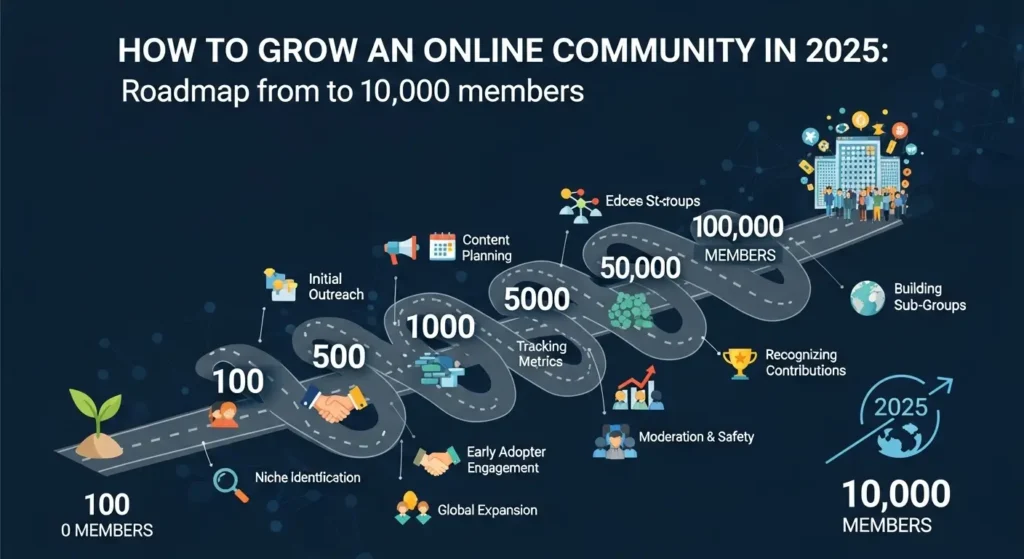
How to Grow an Online Community in 2025: Roadmap from 0 to 10,000 Members
Introduction
Building a vibrant online community isn’t just about numbers—it’s about connection, trust, value, and momentum. In 2025 particularly, with rising expectations for privacy, personalization, meaningful engagement, and AI-powered experiences, growing a community from zero to 10,000 requires intention, strategy, and the right tools.
I’m going to take you through a step-by-step roadmap—what to do first, what to build in the middle, and how to scale—grounded in recent trends and actionable advice. By the end, you’ll know what to start now, what to measure, and how to grow sustainably and meaningfully.
Roadmap: From 0 → 10,000 Members
Step 1: Clarify Purpose, Niche, & Value Proposition (Weeks 0-2)
Before you invite anyone, get crystal clear on:
- Who your community is for. (Demographics, interests, pain points)
- What problem or experience they share, and why they’d want to gather together.
- What unique value you offer (expertise, tools, events, support, peer networking, etc.)
Why this matters: In 2025, niche and micro-communities are rising. Deep connection beats broad but shallow reach.
Actionable tasks:
- Perform audience research: surveys, polls, interviews.
- Check relevant existing communities: what works, what doesn’t.
- Pick your founding principles: tone, values, rules.
Step 2: Choose the Right Platform(s) (Weeks 2-4)
Your platform shapes how people engage. In 2025, many community builders use a dual-platform approach: social media to attract people + a dedicated community space for deeper connection.
Key options:
| Platform type | Pros | Cons / Watch-outs |
|---|---|---|
| Social media groups (Facebook, WhatsApp, Telegram, Discord) | Low cost, easy onboarding, discovery via existing networks | Algorithms, limited ownership, less control on branding & features |
| Dedicated community platforms (Circle, Mighty Networks, Bevy, etc.) | Full control, better structure, analytics, customization, better member experience | May cost more, require more work to seed engagement early. |
Tactics:
- Start with one social channel and one dedicated platform.
- Ensure that the platform supports mobile, notifications, private groups, events, moderation tools, analytics.
- Use AI tools (if available) for moderation, personalization, surfacing relevant content.
Step 3: Seed the Community (Weeks 4-8)
Getting your first ~100-500 members is the hardest part. Here’s how to bootstrap:
- Leverage existing network: Invite friends, colleagues, email list, social followers. Personal invites matter a lot.
- Create foundational content: Make high-value content that speaks to core problems or interests. For instance, guide, how-to, video, webinar, toolkit.
- Host launch event or live session: A webinar, a live Q&A, or virtual meetup creates urgency and draws people in.
- Offer incentives for early members: special recognition, badges, access, or benefits (inside knowledge, premium content). It builds loyalty.
Step 4: Drive Growth via Social Discovery & Content (Weeks 8-16)
Once you have a core group, focus on driving discovery:
- Use social platforms for content marketing:
- Reels / Shorts / TikToks summarizing community takeaways.
- LinkedIn posts or newsletters if your audience is professional.
- YouTube or podcasts for long-form topics.
- SEO & Content Strategy:
- Write blog posts / guides aligned with what people search (use tools to find keyword demand).
- Optimize the site / community landing pages so you show up for searches like “how to ___ group”, “best community for ___”, etc.
- Partnerships & Collaborations:
- Collaborate with influencers, content creators, or existing communities in your niche.
- Guest posts, co-hosted events, shared content.
- Paid promotion (if budget permits):
- Social ads targeting people with interest in your niche.
- Retargeting people who visited your site but didn’t join.
Step 5: Deepen Engagement & Retention (Weeks 16-32)
Growing to 10,000 isn’t just about signups—it’s about people sticking around, participating, and feeling a sense of belonging.
Strategies for engagement:
- Micro-communities / Sub-groups: Break the larger community into smaller cohorts or interest-based groups. Members feel seen.
- Regular events: Weekly or monthly virtual meetups, AMAs, workshops, or hybrid events (both online & offline where possible).
- User-generated content: Encourage member stories, contributions, case studies. Spotlight super-users.
- Ambassador / moderator programs: Identify enthusiastic members, empower them, reward them. They help with moderation, engagement and growth.
- Use AI for personalization & moderation: Tools to surface relevant discussions for each member, notify them of content they’ll like, and remove spam or problematic behavior proactively.
Step 6: Scale Growth (Weeks 32-52+)
When you have several hundreds (500-1,000) active members and engagement patterns are established, scale deliberately.
- Refine your content pipeline: More content, more formats (video, audio, written, interactive), regular schedule.
- Optimize onboarding flow: Make joining smooth; first-day / first-week experiences must hook users: welcome messages, orientation, suggested content or groups.
- Monetization & revenue (optional but helpful): If relevant, introduce paid memberships, premium content, workshops, or product tie-ins. Recurring revenue helps you put resources into better experience.
- Leverage analytics & feedback loops: Track engagement metrics (active users, retention, participation rates), survey members. Use data to drop what’s not working, double down on what is.
- Expand channels & reach: More social platforms, translated content (if you want global audience), community partners.
- Ensure governance & community health: Clear rules, good moderation, policies around privacy & safety, inclusivity. This sustains trust and word-of-mouth.
Tools & Trends You Should Use in 2025
Here are some of the important trends and tools you should build into your strategy:
- AI-powered moderation / personalization / content suggestions.
- Hybrid & micro-communities. Smaller, topic/interest based, more intimate.
- Dedicated community platforms like Circle, Mighty Networks, Bevy, etc.
- Newsletters & email as owned channels. They bypass algorithm changes.
- Exclusive / invite-only groups for more trust, community identity.
- Voice, audio rooms, live streaming, video events as means to connect & bring personality.
- Search + AEO (Answer Engine Optimization): in 2025, people often ask via voice assistants or AI tools; optimize content to be featured in answers.
- Analytics & data-driven decision making. Build dashboards for tracking growth, retention, content performance, engagement metrics.
Example Timeline & Targets
Here is a possible milestone plan (you can adjust based on niche, resources):
| Time Period | Key Milestones |
|---|---|
| Weeks 0-4 | Define niche, clear value, pick platform(s), create initial content and onboarding experience. |
| Weeks 4-12 | Acquire first 100-500 members, host launch event, refine onboarding. |
| Weeks 12-24 | Grow to 1,000-3,000 members, establish sub-groups / ambassadors, start regular events. |
| Weeks 24-40 | Reach 5,000+ members, test monetization, expand content formats, partnerships. |
| Weeks 40-52+ | 10,000 members, strong retention (e.g. 30-50% active in any given period), sustained engagement & revenue (if part of your model). |
Pitfalls to Avoid
- Growing quickly but ignoring community health: spam, low engagement, many lurkers.
- Relying too heavily on platforms you don’t control (Facebook groups, TikTok etc.) without owning an asset (site, platform, email list).
- Not investing enough in moderation, rules, conflict handling.
- Not measuring or ignoring feedback.
- Trying to do everything at once – better to do fewer things well.
Conclusion & Call to Action
Growing an online community in 2025 from 0 to 10,000 is absolutely possible—but it requires planning, persistence, and pivoting based on what works. Focus first on clarity: who you serve, why they’ll join, and how you deliver value. Use social media as a way to discover people, but aim to move them into spaces you own and control. Deep engagement and trust are what turn strangers into loyal members.
If you implement just one piece of this roadmap in the next week, make it either (a) improving your onboarding experience or (b) hosting a high-value event. Those typically yield big returns early.